

Year 6
Welcome to Year 6
We hope all families have had a fantastic summer holiday and we look forward to welcoming Year 6 children back into school on Monday 7th September, at 8.30am, for the start of Term One wearing their full school uniform. (P.E. kits will need to be worn to school on a Friday this term and swimming kits brought in on a Wednesday). The school gates will be open for all at 8.20am and classrooms can be accessed (by pupils) from 8.30am.
Year 6 children are best entering the school site via the main entrance, assembling in the playground before heading to the year 6 entrance from the garden. This enables them to quickly reach their new Year 6 cloakroom followed by their classroom.
Please ensure all children bring a packed lunch and water bottle with them each day.
If you have any questions, for your child’s class teacher, please contact the school office and we will get back to you. ‘Open Door Friday’ continues in Year 6; this is a great opportunity to celebrate your child’s work and become familiar with their classroom.
We look forward to seeing as many parents as possible at ‘Meet The Teacher’: a short meeting designed for parents to hear key information, from class teachers, about the school year ahead and weekly routines in Year 6.
Year Six Teachers:
Mrs. Pearson and Miss. Russett (6PR) and Mr. Smith (6S)
EXPECTATIONS
- P.E. days this term are: Wednesday – Swimming and Thursday- Tag rugby Please wear your P.E. kit to school on Thursday (House T-shirt, plain black (or dark Navy) shorts or joggers/leggings, trainers and School Jumper) Wednesday's swimming kit comprises of a swimming costume, swimming cap, a towel and goggles.
– On Monday, Homework & Spellings will be given to your child and recorded in their Homework Book. Homework Books, online apps and Reading Records need to be completed and, if necessary, brought into school on Friday for your teacher to check. In Year 6, the expectation is that Homework should total around 2 hours a week: this should be a combination of spelling practice, online apps and set homework tasks (Maths/English/Foundation).
– Reading at home in Year 6 this should happen every day. This can be in a variety of forms, such as: children reading independently, sharing a chapter together and reading on Fonetti (if your teacher has given you access). Also, remember reading to your child and listening to audiobooks is extremely beneficial too! Reading Records should be signed off by an adult, but we expect Year 6 children to record their own independent reading journey themselves. Reading Records should be transferred between home and school every day. Please ensure Accelerated Reader quizzes are completed within 48 hours of finishing the book. See below for the links to assist with reading using apps and AR Quizzes. We expect every child to complete a minimum of 3 quizzes every term.
HOMEWORK
Term 1
Homework will be set on Mondays
Spelling
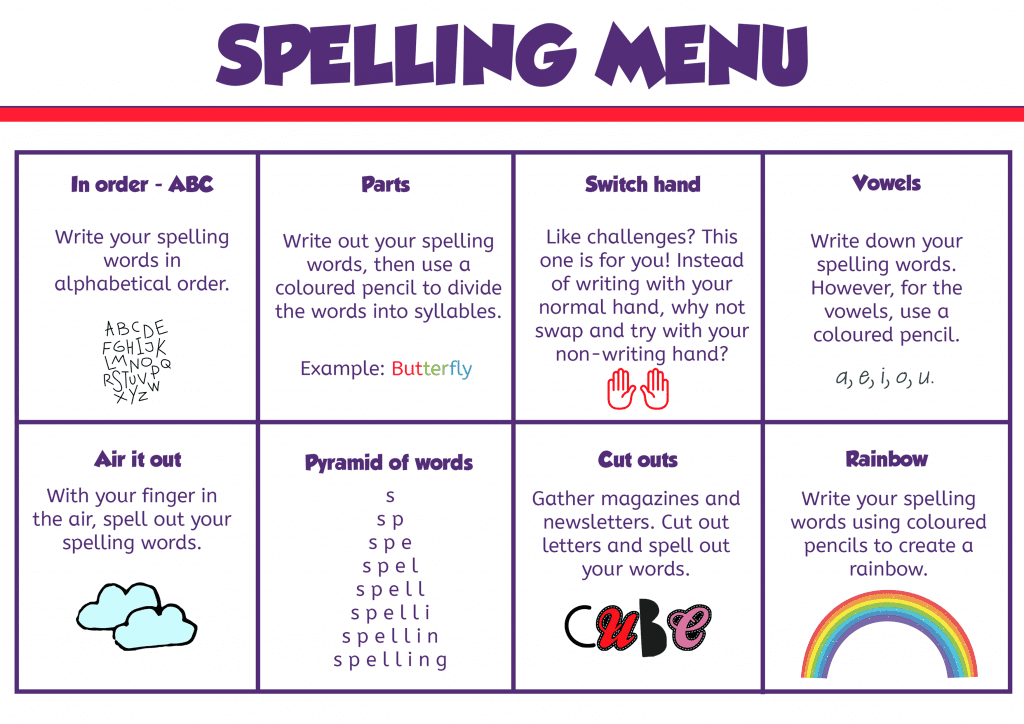
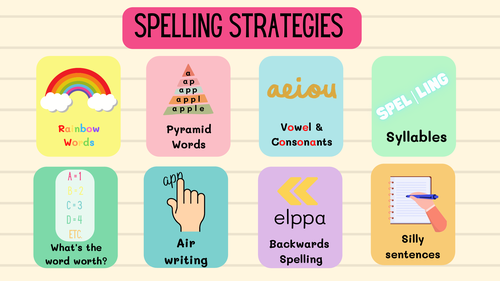
Please take a further page of your book to practise your spellings throughout the week using the strategies below.
Here is a PDF to look at the different methods you could use. SPELLING STRATEGIES
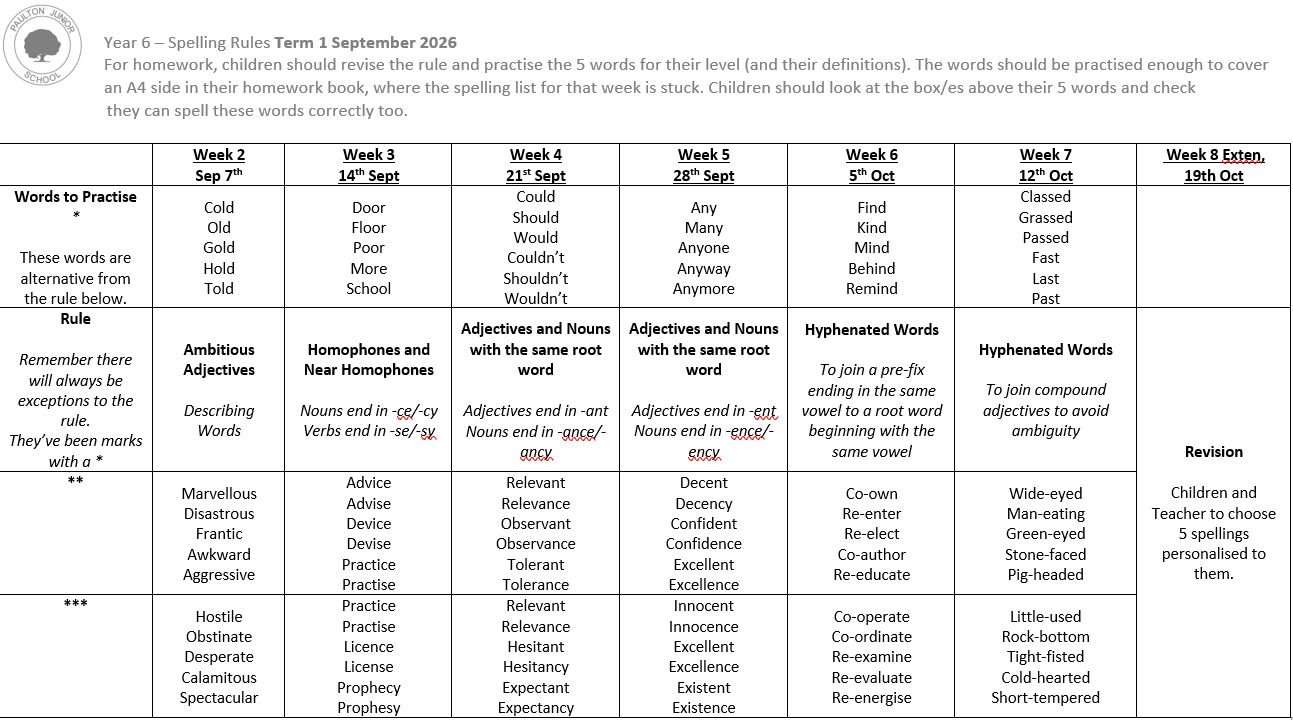
Term 1 Spelling overview
Reading (daily)
Reading should happen every day. It can take a variety of forms, such as children reading independently and sharing a chapter together. Remember that listening to audiobooks can be very beneficial too.
Adults, please remember to listen to children read and sign their Reading Records a minimum of 3x per week. Children can also record any independent reading they do too.
Doodle Maths (5-10 minutes per day)
Children are expected to complete their Daily Questions every single day after being given their personal login details.
Please stay in the GREEN ZONE on this App through daily work both in school and at home.
Online Apps
Children’s log-ins can be found on the inside cover of their Homework Book. If you are having problems with these websites, please let us know as soon as possible.
Times Table Rockstars – https://play.ttrockstars.com/auth
Doodle Maths – https://students.doodlelearning.com/
Accelerated Reader (Book Quizzes) – https://global-zone61.renaissance-go.com/welcomeportal/6699465
These quizzes are usually completed in the school building but if your child is absent from school, completes books and wishes to quiz then please encourage them to use this link.
Fonetti App Download (not for every child) – https://www.fonetti.com/try-out-fonetti/
For reference:
MEDICATION
If your child requires medication to be kept in school (including inhalers), please ensure it is in their school bag that is kept at their desk throughout the day. If your child has additional medication, please ensure the office has been informed and parental consent has been given for us to administer it.
UNIFORM AND KIT
Forest School – wellies/boots and waterproofs. Children should have these in school if they wish to use the playscape and field in the autumn and winter months.
Please note that the appropriate uniform and PE are also required. Children should not be wearing jewellery (unless it is one pair of stud earrings which must be removed for PE). All kit/clothing should be named. If you do not have the suitable kit, please let your teachers know. Please contact the office if you have any issues with the appropriate clothing.
CLUBS AND MUSIC LESSONS
Club opportunities will be presented to the children early this term and parents will be contacted regarding how to book their child a place at these fantastic opportunities.
To sign up for music lessons, please see the links below:
Rocksteady – https://www.rocksteadymusicschool.com/
Other Music Lessons – https://uksouthglos.speedadmin.dk/registration#/
Email: music@wema.org.uk
COMMUNICATION
Homework queries can be communicated through the Homework Books. All other queries should now go through the office (paulton_jun@bathnes.gov.uk) or give us a call on 01761 418137. Additionally, we will have Open Door Fridays where you may come into the classroom to see children’s work.
TERM 1 CURRICULUM OVERVIEW
English:
This term in English, we will be starting our Writing unit entitled 'The Giant And The Sea' by Trent Jamieson in which we read the picture book as a class and discuss the themes introduced in this narrative. We then use this text to inspire our own writing using the author's style as a springboard to innovate the storyline and create writing from the perspective of different characters.
We focus our grammar and punctuation learning on the use of varied sentence structure and how to separate clauses with the accurate use of commas. The identification and punctuation of fronted adverbials is also a focus this term.
Reading lessons begin with the The Nowhere Emporium by Ross Mackenzie. We stumble upon The Nowhere Emporium, with its vast labyrinth of passage ways and rooms, and discover wonders beyond our imagination.
Maths:
This term , our maths learning will focus on building strong foundations in several key areas. We begin by exploring place value, helping children understand the value of digits in numbers up to ten million. We then move on to rounding numbers to the nearest 10, 100, 1,000 and beyond, which supports estimation and accuracy in calculations. The children will also work on inverse operations (such as using subtraction to check addition answers) to deepen their understanding of number relationships. In addition, we will tackle worded reasoning problems, encouraging pupils to apply their mathematical thinking in real-life contexts. A focus on common multiples and factors will strengthen their understanding of number patterns and support their mental maths skills. Throughout the term, we will also place a strong emphasis on arithmetic, ensuring children are confident and fluent with core calculations including addition, subtraction, multiplication, and division.
Foundation Subjects
Geography: This term, we find out about the Amazon region of South America, considering what it is like to live in the region as well as how it is being damaged and how it can be protected. The unit builds on previous work the children have done on rainforests, climate and North America in previous geography work throughout key stage two.
Art: This term in Art, we develop drawing skills, with a particular focus on using pencil techniques to create tone, texture, and depth. Children practise observing and sketching natural objects such as leaves, shells, and plants, learning how to use shading to bring their drawings to life. Building on these skills, they then explore the process of lino printing, using their drawings as inspiration to design and carve their own lino relief prints. This exciting module combines creativity with precision, giving pupils the opportunity to experience the full artistic process – from initial sketch to final print – while developing confidence and control in their work.
PSHE: In PSHE this term we are learning how to be Me in My World. As we look ahead to the new school year, children are setting personal goals, sharing hopes, and learning how to make everyone feel welcome and valued. Together, we are exploring global citizenship, children's rights, and how our choices affect others both locally and worldwide. By understanding how rights, responsibilities, rewards, and consequences work together, children will collaborate to build our shared Learning Charter, discovering how democracy and positive choices help create a happy, supportive school community.
R.E: In R.E., we consider what it means to be a Christian in modern Britain. We will explore questions like: What rituals or ceremonies might a Christian be asked to celebrate in order to be a member of their faith? How might Christian be expected to serve their community and other people?
Science: This term in Science, we are exploring the fascinating topic of light. Pupils investigate key scientific concepts, including how light travels in straight lines and how it interacts with different materials. They will learn about reflection, understanding how and why we see things, and how mirrors work. Through practical experiments and investigations, children will observe how light behaves and consider real-world applications of these ideas. This engaging topic encourages curiosity, critical thinking, and the development of key scientific skills such as predicting, observing, and drawing conclusions.
P.E and Games: This term, we build upon our invasion game skills in tag rugby on a Thursday and swimming skills on a Wednesday.
Lesson Resources